|
E-Newsletter • January 2026 |
▼ ADVERTISEMENT

Editor's E-Note
Happy New Year! As we kick off the year, we’re looking at how medical imaging is evolving to meet today’s needs. Despite looming challenges, its utilization continues to grow, increasing precision and allowing for more personalized care.
For more of the latest imaging news, visit us on X, formerly known as Twitter, and/or Facebook.
Enjoy the newsletter.
— Dave Yeager, editor
|
|
|
| In This E-Newsletter
|
▼ ADVERTISEMENT
 |
|
|
The New Age of Medical Imaging
How CT, MRI, X-ray, and Ultrasound Are Reshaping Modern Diagnosis
By K. Sri Lakshmi
Medical imaging has become one of the most influential forces in modern health care. People may picture a hospital as a place of physicians, medications, and operating rooms, but, increasingly, diagnosis and treatment hinge on the pictures captured by advanced imaging tools. From trauma centers to outpatient clinics, imaging now serves as the backbone of decision making, guiding clinicians with a level of clarity that would have seemed unimaginable only a generation ago. As technology evolves, imaging is no longer simply about discovering what is wrong; it is becoming a way to predict what may happen next.
Medical imaging is also experiencing a shift in the way physicians interact with patients. Clinicians increasingly use imaging results as a communication tool, allowing patients to see what is happening inside their bodies rather than simply hearing about it. This visual form of explanation helps improve understanding, particularly for individuals navigating complex diagnoses. Many health care providers report that patients feel more confident in their treatment plans when they can view their images directly and participate in discussions about findings.
▼ ADVERTISEMENT

Another emerging development involves workflow redesign. Hospitals are restructuring imaging departments to reduce wait times and improve patient flow. Instead of sending every case through a traditional interpretation pipeline, some facilities experiment with rapid-read stations for urgent findings, enabling faster clinical decisions. These operational changes are becoming more common as patient volume grows and expectations for quick results increase.
There is also increasing interest in environmental responsibility within imaging departments. Medical centers are examining the carbon footprint associated with imaging operations, from equipment energy use to waste disposal. Some institutions are setting sustainability goals by investing in more energy-efficient devices, optimizing scan protocols, and reducing unnecessary repeats. Environmental stewardship is becoming a talking point in radiology, reflecting the wider health care movement toward greener practices.
|
Imaging Identifies Differences in Brains of Autistic People
A study from Yale School of Medicine used MRI and PET to identify notable differences in the brains of autistic people, compared with neurotypical people.
New Insights Into Stimulant ADHD Medications
A study from Washington University in St. Louis found that stimulant ADHD medications, such as Ritalin and Adderall, work in a way that is different from what was previously thought.
Device Separates Cancerous Cells From Healthy Cells
Researchers at Stanford University have developed a tool that uses electromagnetic levitation to direct the movement of cells. Among its applications, it may prove useful for studying cells in low-volume biopsy samples.
Novel Approach to Recurrent Prostate Cancer Treatment
A clinical trial at UCLA Health is the first to directly compare the results of treatment with lutetium-177–PSMA-617 vs actinium-225–PSMA-617. Both therapies are being administered in conjunction with stereotactic body radiotherapy. |
“This is such profound science to follow right now because we have drugs that can treat obesity quite powerfully, which means we could track the effect of weight loss drugs on Alzheimer’s biomarkers in future studies. It’s marvelous that we have these blood biomarkers to track the molecular pathology of Alzheimer’s disease and MRI scans to track additional evidence of brain degeneration and response to various treatments. This work is foundational for future studies and treatment trials.”
|
|
|
COVER STORY
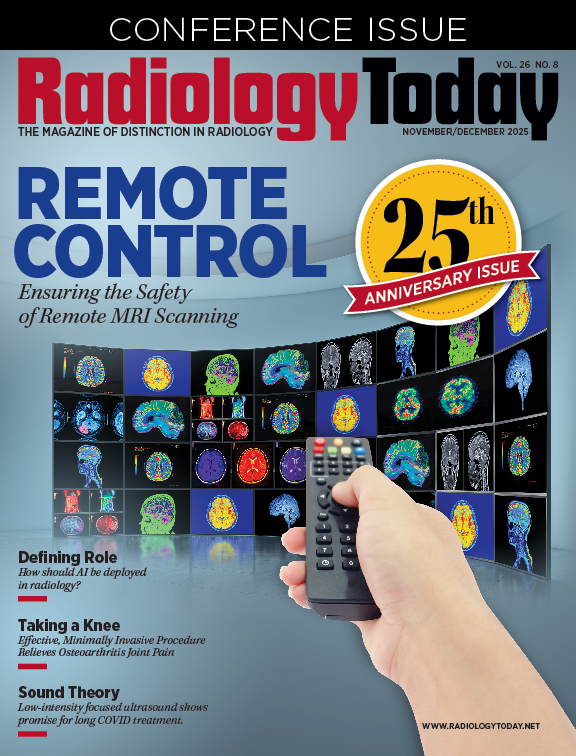
Remote Control
Staff shortages and high demand are stretching hospitals’ and imaging centers’ ability to provide MRI exams. To meet this need, more providers are exploring remote MRI imaging to fill the gaps.
FEATURE
Taking a Knee
Osteoarthritis can cause debilitating knee pain, and current treatments are less than ideal. A minimally invasive procedure is showing potential not only for treating symptoms but also for addressing the underlying disease.
|
|
|
| Advertising Opportunities |
Have a product or service you want to market to radiology professionals? Utilize the reach of Radiology Today Magazine to accomplish your marketing goals. Email our experienced account executives today at sales@gvpub.com or call 800-278-4400 for more information.
|
| © 2026 Radiology Today Magazine |
|
|