|
E-Newsletter • March 2026 |
▼ ADVERTISEMENT

Editor's E-Note
Minimally invasive procedures are useful for many conditions, and the list keeps growing. This month, we’re highlighting a couple of use cases that benefit from IR.
For more of the latest imaging news, visit us on X, formerly known as Twitter, and/or Facebook.
If you happen to be at the Society of Interventional Radiology meeting in Toronto, stop by booth #1815 and say hi. We always appreciate meeting our readers.
Enjoy the newsletter.
— Dave Yeager, editor |
|
|
| In This E-Newsletter
|
▼ ADVERTISEMENT
 |
|
|
Practice Guidance for Chronic Pelvic Pain Treatment
The Society of Interventional Radiology (SIR) published new practice guidance for the treatment of chronic pelvic pain (CPP) in women who suffer from a pelvic venous disorder. The guidance was published online in the Journal of Vascular and Interventional Radiology.
Pelvic venous disorders encompass a range of symptoms caused by conditions such as venous reflux or obstruction of the inferior vena cava, ovarian, iliac, and/or left renal veins. Many women with these conditions suffer from CPP, which can be treated by an interventional radiologist. Because venous-origin pelvic pain is often confused with gynecological issues, many women go undiagnosed or misdiagnosed, prolonging their suffering.
This document provides evidence-based guidance for health care providers on the clinical evaluation of venous-origin CPP, appropriate diagnostic and preprocedural imaging, and appropriate treatments tailored to the diagnosis—ranging from pharmacological treatment to interventions, such as embolization or stenting.
“While many people assume chronic pelvic pain is gynecological in nature, studies show that more than 80% of women with CPP do not have a gynecological problem,” says SIR President Robert A. Lookstein, MD, FSIR. “Because of the misconceptions about the causes of CPP, it can be hard for women to obtain a diagnosis and find treatment. We hope this guidance changes that dynamic and ensures that women get access to the care they need without delay.”
|
|
|
▼ ADVERTISEMENT
  |
|
|
Brain Scans Show Why Some Kids Struggle With Math
A recent study using functional MRI showed that children who struggle with math have difficulties with symbolic numbers and in updating their problem-solving strategies. The findings may help teachers adapt their teaching methods to address these issues.
CT Scans Have More to Offer
There is a great deal of data associated with CT scans that is not being utilized. Shifting paradigms toward opportunistic imaging can deliver significant benefits to patients and health systems.
▼ ADVERTISEMENT
Brain Network Responsible for Parkinson’s Disease Identified
An international study identified the somato-cognitive action network as the brain network that is affected by Parkinson’s disease. Using transcranial magnetic stimulation therapy, the researchers noted significant improvement in symptoms when stimulating this network, compared with other brain networks.
Intraoperative MRI Enhances Brain Surgery
Surgeons at the University of Chicago are using intraoperative MRI to perform functional, real-time imaging during surgery. The state-of-the-art technology detects potential complications in as little as seven seconds. |
▼ ADVERTISEMENT

“Variability in typical language development can result in language delays going unidentified for years. Late identification leads to valuable time lost—time that the child could have been receiving early intervention services.”
— Yuhan Chen, PhD, a research assistant professor of radiology at the Children’s Hospital of Philadelphia, who is leading a longitudinal study that will use neuroimaging techniques such as magnetoencephalography and MRI to measure brain structures in the language areas of preschool-aged children |
|
|
COVER STORY
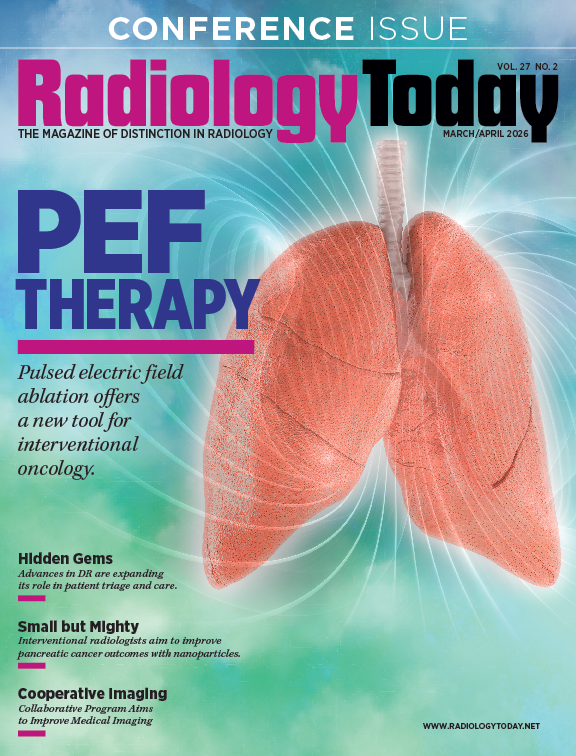
PEF Therapy
Pulsed electric field ablation has shown promising results in helping to control lung tumors in metastatic cancer patients. Although more research is needed, the procedure may offer a new tool in the fight against lung cancer.
FEATURE
Hidden Gems
DR has long been a frontline modality, but advancing technology is expanding its utility.
|
|
|
| Advertising Opportunities |
Have a product or service you want to market to radiology professionals? Utilize the reach of Radiology Today Magazine to accomplish your marketing goals. Email our experienced account executives today at sales@gvpub.com or call 800-278-4400 for more information.
|
| © 2026 Radiology Today Magazine |
|
|