


At RSNA 2025, manufacturers emphasized a clear shift in ultrasound. The modality continues to evolve at a remarkable pace, driven by the dual forces of rising imaging demand and the industry’s urgent need for greater reproducibility, workflow efficiency, and operator independence.
Ultrasound is no longer just a flexible diagnostic tool but also a foundational modality increasingly powered by AI, advanced beamforming, and integrated data intelligence. Here is a look at what companies showcased and what’s ahead.
GE HealthCare
GE HealthCare’s updated portfolio centers on cardiovascular performance, AI-driven workflow automation, and point-of-care usability. Philip Rackliffe, president and CEO of the company’s Advanced Visualization Solutions, says the company’s new Vivid Pioneer cardiovascular system elevates image clarity and diagnostic precision.
“The system offers extraordinary 2D, 4D, and color flow imaging clarity powered by the next-generation cSound Pioneer architecture and a new 6Sc-D probe engineered for higher resolution and wider views,” he says.
A major theme for GE HealthCare is AI integration designed to accelerate workflow and reduce variability—particularly in cardiology, where complex measurements can slow exam throughput. “On Vivid Pioneer, AI algorithms accelerate cardiac ultrasound automation and measurement, enabling performance that is up to 360% faster,” Rackliffe says. “Tools like Automated Functional Imaging deliver strain and ejection fraction results in less than nine seconds, allowing users to move through structured cardiac assessments with greater consistency.”
GE HealthCare also emphasizes point-of-care ultrasound (POCUS) across its Venue family of systems, highlighting real-time decision support tools such as Caption Guidance, which offers “prescriptive instructions and a quality meter for diagnostic-quality cardiac images,” and Nerveblox, which “automatically labels key anatomical landmarks for peripheral nerve blocks.” These advancements are intended to broaden POCUS adoption beyond expert users, helping clinicians in emergency and critical-care settings acquire confident, reproducible images more quickly.
With staffing and workflow stressors continuing across imaging departments, GE HealthCare is prioritizing efficiency. Rackliffe says tools such as Auto Bladder Volume dramatically reduce exam clicks, while cardiac automation on Vivid Pioneer helps reduce exam time and improve throughput. The company also showcased enhanced ergonomics, modular design, and battery-backed mobility to ensure continuity of operation across departments.
Rackliffe expects advances in transducer materials, deeper AI integration, and more automated 3D/4D workflows to have the greatest impact on radiology. “Next-generation transducer designs like the 6Sc-D probe will push the boundaries of visualization for diverse patient populations, while maturing AI technologies will continue to standardize diagnoses and reduce operator variability,” he says.
Philips
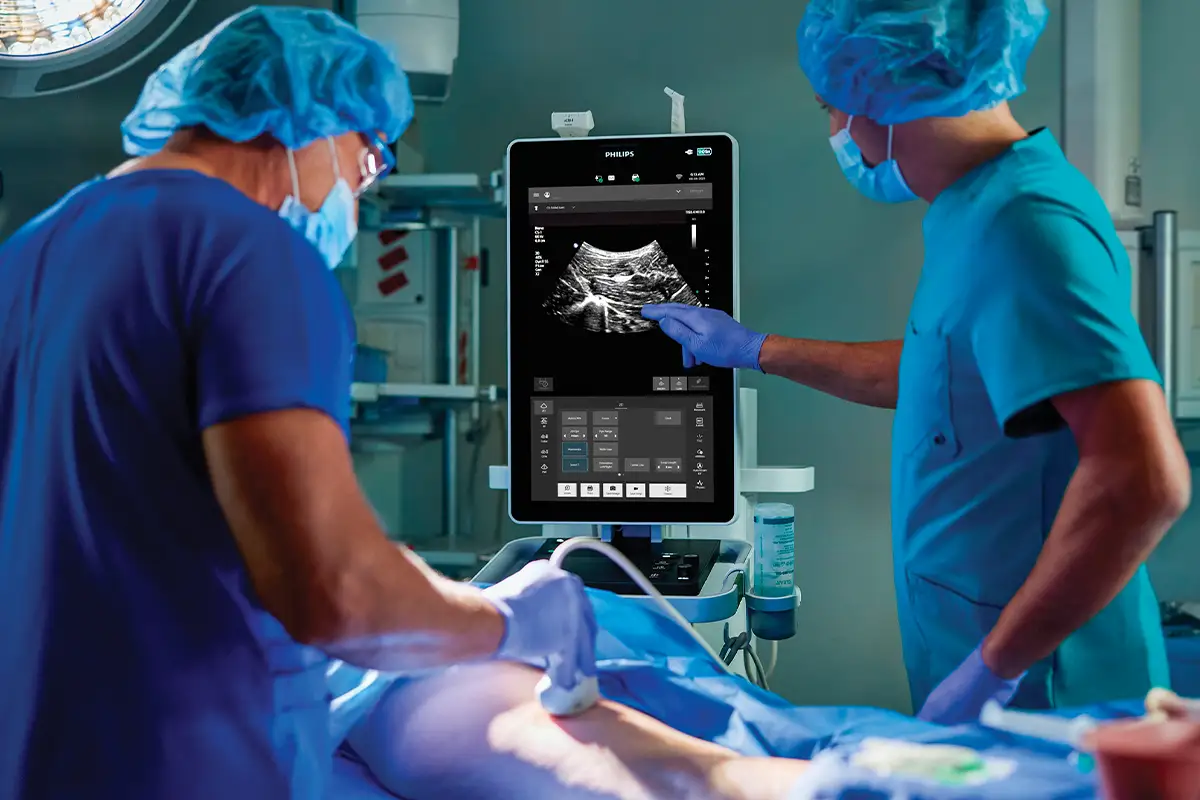
Philips presented a strategy built around image quality elevation, workflow simplification, and enterprise-level operational efficiency, anchored by a universal platform that supports modular upgrades and consistent user experience across systems. Overall, there were four new ultrasound products, including updates to the EPIQ Elite and Affiniti platforms, reflecting the growing need for better throughput and higher quality imaging amid workforce shortages.
“The Elevate release delivers enhanced image quality and improved workflow through AI-powered optimizations and upgraded beamforming,” says Jeff Cohen, business leader for Philips Ultrasound.
Philips highlighted gains in automation, particularly in abdominal and liver imaging, using tools such as Auto ElastQ. The company says its AI-driven shear-wave elastography technology is designed to automate liver stiffness measurements, reducing exam time by as much as 60% and improving reproducibility. Philips’ library of tissue-specific presets and auto-brightness optimization tools reduce manual adjustments by up to 54% in button pushes, allowing radiologists and sonographers to maintain consistent image quality regardless of operator skill level.
Workflow standardization remains central to the company’s strategy. Quick Launch presets enable fast abdominal exam setup, which Philips says can slash imaging acquisition time by up to 50%. Digital enhancements such as remote software management and Collaboration Live enable real-time virtual diagnostics and quality assurance, with the latter reducing exam time by up to 57%, according to the company, while allowing up to six users to participate in a session.
Point-of-care expansion is another priority. Philips introduced the Flash 5100 POC system, designed for high-stress environments such as emergency and critical care. The platform shares transducers and user interface familiarity with the broader Philips portfolio, enabling providers to standardize fleets and lower training burdens. The company also updated its handheld Lumify system with new AI-driven auto-EF capabilities and B-lines quantification, to extend high-quality diagnostic insights to mobile care environments.
On the sustainability front, Philips is emphasizing modular upgrades, shared accessories, and refurbished Circular Edition systems aimed at reducing lifecycle costs and environmental impact. Company leaders say 85% of end-of-life systems can be reused or recycled.
Philips sees AI-powered reconstruction, cloud-based collaboration, automated quantification, and predictive analytics driving the next phase of ultrasound innovation. The company says it’s committed to 12- to 18-month innovation cycles that keep its universal platform up to date while strengthening long-term operational value for health systems.
Fujifilm
Fujifilm highlighted significant strides in image quality, noise suppression, and real-time cognitive processing, showcasing its DeepInsight technology. Connie Casey, director of ultrasound marketing, describes DeepInsight as a cognitive approach designed to “distinguish between echo signals and electrical noise” while maintaining important speckle information.
At RSNA, the ARIETTA 750 DeepInsight platform served as the company’s flagship, featuring advanced beamforming, uniform clarity enhancements, and high-performance 3D/4D applications. Fujifilm highlighted technologies such as Detective Flow Imaging and eFLOW to support complex hemodynamic assessments, alongside Carving Imaging for fine structural detail and WIDESCAN for a 150-degree anatomical field of view.
“The system’s cognitive processing works in real time, enabling sonographers to identify areas of interest more easily during acquisition—especially important as patient populations become more complex,” Casey says.
Automation was another focal point. Fujifilm introduced Next-Generation Auto Optimizer, which analyzes every pixel instantly to deliver optimal clarity without manual input. “Automated fetal measurements—including heart rate and fractional shortening—aim to reduce variability and improve obstetric workflow consistency,” Casey says.
The company also emphasized shearwave elastography with tools such as iATT, which allows clinicians to evaluate both fat and stiffness parameters from a single acquisition, supporting early detection and monitoring of liver steatosis. On the quantitative side, Fujifilm’s improved signal-to-noise ratio and elastography advances enhance both lesion characterization and liver fibrosis assessment. These tools are designed to provide more confident diagnoses while addressing reproducibility challenges across operators and sites.
To address staffing shortages and training limitations, Fujifilm has invested heavily in guided protocols and intuitive interfaces. Casey says the ARIETTA DeepInsight systems help reduce the number of manual actions needed to complete an exam, improving throughput and boosting consistency among less-experienced users. The platform’s enhanced menus and workflow design also streamline onboarding.
Fujifilm sees Next-Generation Auto Optimizer, fully automated fetal measurements, and expanded elastography analytics as key growth areas. “These technologies will elevate diagnostic confidence and deliver increasingly standardized imaging across applications,” Casey says.
Samsung
Samsung’s portfolio is anchored by the debut of the R20 ultrapremium ultrasound system—designed to meet the demands of increasingly complex patients and rising exam volumes. Anthony Tardi, head of marketing for ultrasound, radiography, and mobile CT, says the R20 integrates a new imaging engine combining digital beamforming and adaptive image processing to provide high diagnostic clarity in the most challenging exams while minimizing acquisition difficulty for users of all skill levels.
“AI-powered tools were central to Samsung’s message, particularly real-time assistance features designed to guide users during scanning,” Tardi says. “Live LiverAssist and Live BreastAssist help detect and track pathology dynamically, as well as NerveTrack, which detects and tracks up to 13 nerves and surrounding structures to support precision during nerve-related assessments.”
Automation also contributes measurable gains. Tardi says automation has reduced acquisition times of liver elastography by up to 57%. Point-of-care was another major emphasis.
“Samsung aims to deliver high-quality imaging without user interaction, ensuring clinicians in emergency and critical-care settings can obtain reliable images quickly,” Tardi says. “By leveraging [central processing unit] innovation, rather than costlier [graphics processing unit] architectures, Samsung is bringing AI capabilities across our portfolio, helping broaden access.”
In quantitative imaging, Samsung introduced Deep Learning Ultrasound Fat Fraction (USFF), designed for early detection of liver disease. Tardi says USFF correlates closely with MRI-PDFF (proton density fat fraction) and provides liver fat percentage measurements that are AI-powered to increase accuracy across levels of disease.
“By addressing limitations of conventional attenuation-based tools, USFF aims to deliver more consistent insights across both early and late disease stages,” Tardi says.
Ergonomics and workflow efficiency are also high priorities. Company research shows that a vast majority of sonographers scan in pain. The R20 is engineered to meet stringent ergonomic standards to help reduce musculoskeletal injuries. AI features also minimize repetitive actions and reduce variability across users.
Moving forward, Tardi expects AI to become part of every aspect of image optimization, from automated annotations to real-time pathology characterization, supporting a fully integrated imaging-to-reporting workflow.
Siemens Healthineers
Siemens Healthineers highlighted ultrasound’s evolving role as a modality focused on workflow relief, reproducibility, and expanded clinical impact. “We’re reimagining ultrasound as a precision infrastructure, one that lightens clinical load today and lays the foundation for intelligent, adaptive care,” says Sourabh Pagaria, head of ultrasound for the company. “Ultrasound is a modality which is right now focusing on reducing workflow strain while producing more diagnostic exams than ever and also making ultrasound central to care pathways, including therapies.”
A major focus is “practical AI,” AI embedded directly into the scanning workflow rather than delivered as standalone tools. “AI which is not integrated in the workflow of physicians fails to make an impact,” Pagaria says. “We’re embedding intelligence directly into care delivery. From real-time diagnostics to intraprocedural guidance, we’re engineering ultrasound to think with the clinician. We only focus on AI that clearly integrates at the point of scan and has a clear value proposition in saving time, reducing repeated motions, or lowering variation.”
In abdominal imaging, AI-driven automation now supports organ identification, labeling, and standardized measurements in real time. “The system can automatically capture 17 organs in the abdomen, label them, and perform 12 measurements in milliseconds,” Pagaria says. “That’s a lot of support for radiographers and helps reduce the strain we all talk about.”
Siemens Healthineers is also advancing disease-specific ultrasound solutions, particularly for liver disease, where noninvasive assessment is becoming increasingly important. “We now have ultrasound-based exams that can quantify key features of liver disease, including liver fat content and liver stiffness,” Pagaria says. “This can help identify disease at earlier stages, when it can be better treated, and today that’s especially relevant because the prevalence of metabolic-associated liver disease is only increasing.”
Reproducibility remains a key theme, particularly given ultrasound’s operator-dependent nature. Pagaria says AI-based measurement tools play a critical role in standardization. “When you press one button and have an exact mesh of measurement points placed automatically, you’re not only saving time, you’re increasing reproducibility by many times compared to a manual process,” he says.
In cardiology, AI-assisted workflows are significantly reducing exam time as well. “A standard echocardiography exam can take almost 30 minutes,” Pagaria says. “With AI and automated measurements, that can be reduced by around 10 minutes, which has a big impact on workload and throughput.”
Beyond diagnostics, Siemens Healthineers is increasingly positioning ultrasound as a procedural imaging tool. “In today’s procedural suites, time, precision, and access define outcomes,” Pagaria says. “That’s where ultrasound steps in as radiation-free, always-on, and increasingly intelligent. It’s not just supporting procedures, it’s guiding them.”
POCUS is another growth area, but Pagaria says the company is focused on versatility rather than single-purpose devices. “You don’t know what type of clinical case will show up in the emergency department or outpatient setting,” he notes. “So, we focus on multiuse clinical technology rather than case-specific machines.”
Looking ahead, Pagaria thinks ultrasound will continue to evolve into core clinical infrastructure. “We believe ultrasound is becoming the guidance layer of precision medicine: real-time, intelligent, and foundational to care,” he says.
United Imaging
United Imaging used RSNA to preview uSONIQUE, a next-generation ultrasound platform currently 510(k) pending and not yet available for clinical use. Although still premarket, the company offered a detailed look at how its architecture is intended to address longstanding challenges around variability, workflow fragmentation, and repetitive strain among sonographers.
“Care teams everywhere are overloaded, and variability remains one of the industry’s greatest concerns,” says Steve Millstone, vice president of ultrasound for United Imaging North America. “Traditional AI models have been extremely fragmented, with one-off apps which limit adoption.”
The uSONIQUE platform is designed to deliver a fully integrated, AI-native experience built on United Imaging’s uEDGETEC hardware and software stack. This includes PureGrid next-generation single-crystal transducer technology, xCompute hardware architecture, and MindSpace, its modular AI software environment.
“The structure enables a seamless, holistic AI workflow experience spanning general imaging, cardiovascular, women’s health, and point-of-care applications,” Millstone says.
One of the most notable elements of the platform is its end-to-end AI framework, AI Stream, which orchestrates acquisition, optimization, detection, measurement, and reporting. “When a user approaches the system, uSONIQUE logs him/her in automatically through safe and secure facial recognition loading personalized presets, protocols, and layouts, instantly,” Millstone says. “Instead of selecting probes on screen, users simply pick up the transducer, which activates automatically.”
During scanning, AI continuously adjusts image parameters, automatically refocusing and enhancing tissue borders while actively identifying structures, lesions, and views. “Lesions can be outlined in real time, analyzed, and receive suggested grading based on analysis results, allowing measurements to be performed automatically in the background,” Millstone says. “Structured reports are built dynamically as the clinician scans, and the system standardizes the order of images and clips to support consistency across users.”
Initial feedback at RSNA was positive, Millstone says, with attendees responding to the potential for reduced strain, improved ergonomics, and greater reproducibility.
— Keith Loria is a freelance writer based in Oakton, Virginia. He is a frequent contributor to Radiology Today.