

 March/April 2026 Issue
Editor’s Note: Precise Targeting
By Dave Yeager
Radiology Today
Vol. 27 No. 2 P. 4
Hitting a small target is difficult. Hitting a small, moving target is even more demanding. Whether it be cancerous lesions or workflow improvements, the challenges that radiology faces seem to change size and shift position often. This issue highlights some different ways that those challenges are being addressed.
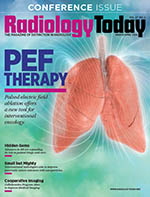
For this month’s cover feature, Beth W. Orenstein has a report on a minimally invasive procedure that has produced promising results. In a multicenter clinical trial that was published in October 2025, pulsed electric field ablation demonstrated high local control of ablated tumors in patients with metastatic nonsmall cell lung cancer, which has a five-year survival rate of 12%. Because the therapy relies on electrical pulses, rather than heat or cold, it may be useful in places that were previously considered poor targets for ablation, such as near nerves, blood vessels, and critical organs. Although more research is needed, the results have generated cautious optimism that the therapy will become an additional tool in the cancer-fighting toolbox.
Another type of cancer with a low survival rate is pancreatic cancer. In its early stages, it produces few noticeable symptoms, and its location makes it difficult, if not impossible, to treat with surgery. But minimally invasive treatments offer hope for more effective treatment options. Orenstein details two of these options: a theranostic treatment and a treatment that uses magnetic nanoparticles to target tumors. The research is still in its early stages, but many researchers believe these methods may point the way toward more targeted and effective pancreatic cancer treatments.
Also, in this issue, we’re covering the latest advances in DR technology. Keith Loria checks in on some of the new features that are expanding DR’s utility. While it has long been a first-line modality, staffing shortages, high exam volumes, and cost pressures mean that physicians and administrators need more than ever from DR, and vendors are doing their best to meet these evolving expectations. AI and automation are changing the way that DR is deployed and enhancing what it can do.
Finally, with all of the challenges medical imaging faces, such as increasing image volumes, higher demand, and staff burnout, the need to reexamine radiology workflows from end to end has never been greater. To achieve this, some academic centers are partnering with industry to improve the state of the art. Jessica Zimmer has a profile of one such effort, a collaboration between the University of California, San Francisco, and GE HealthCare. The partnership touches many aspects of imaging, including scan speeds, quantitative imaging, and effective use of AI.
Enjoy the issue.
— Dave Yeager
david.yeager@gvpub.com
