|
E-Newsletter • April 2026 |
▼ ADVERTISEMENT

Editor's E-Note
Ultrasound is highly useful in many imaging contexts, but reasearchers are also stretching its utility to include delivering therapy. This month’s exclusive highlights a new application that produces light inside bodies and may one day be used to administer minimally invasive treatments.
For more of the latest imaging news, visit us on X, formerly known as Twitter, and/or Facebook.
Enjoy the newsletter.
— Dave Yeager, editor |
|
|
| In This E-Newsletter
|
▼ ADVERTISEMENT
 |
|
|
Ultrasound Facilitates Light-Based Treatments
A new technique using ultrasound waves to activate light-emitting nanoparticles could be used to manipulate cell signals or facilitate light-based medical treatments in the future. Light has an increasing number of applications in biology and medicine—it can be used to stimulate cell growth, manipulate neural signals, and treat some cancers—but it doesn’t easily pass through tissue. Most methods to bring light deep within the body are invasive, requiring either tissue removal or optical fiber insertion.
Researchers at Stanford University have created a noninvasive way to deliver light to specific locations anywhere in the body. Their work, published April 13 in Nature Materials, uses nanomaterials distributed through the bloodstream to turn ultrasound waves into precise points of light. The technique provides a potential roadmap for easier, less invasive light-based treatments.
▼ ADVERTISEMENT

“Ultrasound is very convenient to use, and it penetrates much deeper into the body than light,” says Guosong Hong, PhD, an assistant professor of materials science and engineering in the School of Engineering, faculty scholar at the Wu Tsai Neurosciences Institute, and senior author on the paper. “With these materials, we can produce light emission in the brain, in the gut, in the spinal cord, in the muscle—virtually anywhere—without needing a physical implant.”
|
Questions About fMRI’s Accuracy
Researchers in Germany have found that as much as 40% of fMRI signals, which measure blood flow in the brain, do not correspond to brain activity. The researchers propose supplementing fMRI with quantitative measurements to produce more accurate brain data.
3D Imaging System Maps Blood Vessels and Tissue
Researchers at Keck School of Medicine of the University of Southern California have developed a 3D imaging system that aims to address the limitations of MRI, CT, and ultrasound. The technique combines ultrasound and photoacoustic imaging and can collect 3D images from anywhere in the human body. The system, called RUS-PAT, uses an arc of detectors to collect images generated by ultrasound and laser light.
▼ ADVERTISEMENT

New Oral Contrast Agent Improves CT Visualization
Researchers from the University of Washington; the Mayo Clinic; the University of California, San Francisco; and Nextrast Inc have developed a new oral contrast that addresses common challenges in the diagnosis of bowel diseases. The agent, made of dark borosilicate, was able to image conditions that are often missed with conventional contrast agents.
Deepfake X-rays Fool Radiologists and AI
A recent study found that deepfake X-ray images are realistic enough to fool radiologists, even when the radiologists knew that AI-generated images were present. The study raises questions about cybersecurity risks. The researchers identified common features of synthetic X-rays and included recommendations for digital safeguards. |
▼ ADVERTISEMENT

“While we can use imaging techniques, like angiography, to see blood moving through blood vessels throughout the body, we don’t yet have the technology to be able to see how exactly lymph interacts with tissues and other systems. We hope to discover how the lymphatic system works and contributes to conditions like heart failure, chronic kidney and liver diseases, autoimmune disorders, and possibly even neurodegenerative diseases.”
— Maxim Itkin, MD, director of the Penn Center for Lymphatic Disorders. The Penn Center for Lymphatic Disorders, working with a multidisciplinary team of imaging and chemistry experts at the University of Pennsylvania; Monash University in Melbourne, Australia; and 3DT Holdings and overseen by Kimberley Steele, MD, PhD, a program manager at ARPA-H, is developing an imaging system that will allow advanced imaging of the lymphatic system. |
|
|
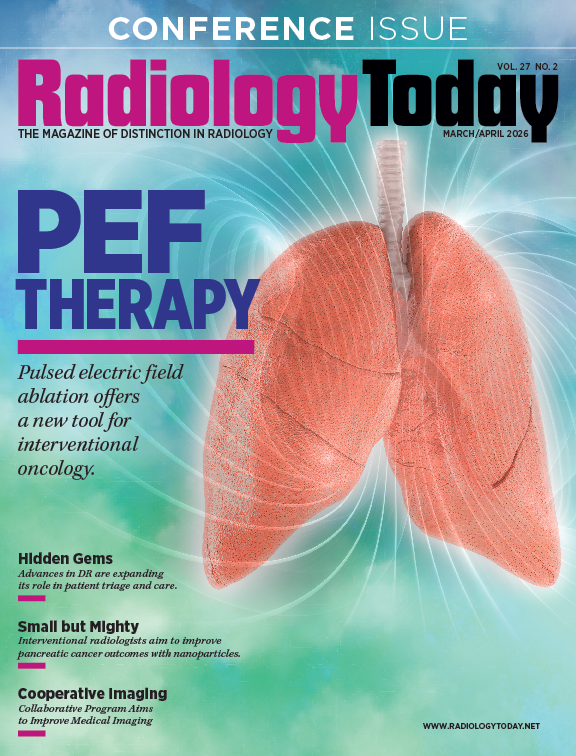
COVER STORY
PEF Therapy
Pulsed electric field ablation has shown promising results in helping to control lung tumors in metastatic cancer patients. Although more research is needed, the procedure may offer a new tool in the fight against lung cancer.
FEATURE
Hidden Gems
DR has long been a frontline modality, but advancing technology is expanding its utility.
|
|
|
| Advertising Opportunities |
Have a product or service you want to market to radiology professionals? Utilize the reach of Radiology Today Magazine to accomplish your marketing goals. Email our experienced account executives today at sales@gvpub.com or call 800-278-4400 for more information.
|
| © 2026 Radiology Today Magazine |
|
|