▼ ADVERTISEMENT

Editor's E-Note
Targeted radiotherapies have improved treatment of some cancers, such as prostate and neuroendocrine tumors, and new radiopharmaceutical treatments offer hope for some of the most intractable cancers. Pancreatic ductal adenocarcinoma, for example, has a five-year survival rate below 5% in patients with metastatic disease, but new research demonstrates a potential radiopharmaceutical treatment pathway. In this month’s newsletter, we’re highlighting the recent preclinical study that investigated this treatment option. We’re also spotlighting a report on a promising theranostic approach to colon cancer treatment.
For more of the latest imaging news, visit us on X, formerly known as Twitter, and/or Facebook.
Enjoy the newsletter.
— Dave Yeager, editor |
|
|
| In This E-Newsletter
|
▼ ADVERTISEMENT
 |
|
|
Targeted Radiopharmaceutical Induces Remission in Pancreatic Cancer Model
A newly developed targeted radiopharmaceutical treatment can effectively slow tumor growth in pancreatic ductal adenocarcinoma (PDAC), according to new research published in the May issue of The Journal of Nuclear Medicine. In preclinical models, the treatment achieved complete remission of the disease, highlighting its potential to transform care for this highly aggressive cancer.
PDAC accounts for over 90% of pancreatic cancer cases and remains one of the most lethal malignancies, with a five-year survival rate of less than 5% in patients with metastatic disease. Although surgery is the only curative approach, it is feasible only in 10% to 20% of patients with localized disease. "PDAC is very difficult to treat, and new options are urgently needed," says Marika Nestor, a professor in the department of immunology, genetics, and pathology at Uppsala University in Sweden. "Our previous findings suggest a possible new targeted treatment approach for pancreatic cancer patients whose tumors express CD44v6, which may help make treatment more precise and effective."
|
|
|
▼ ADVERTISEMENT
  |
|
▼ ADVERTISEMENT
 |
A Precision Lens for Treating Stroke
Researchers believe they can better adapt stroke treatment by studying MRI imaging of the blood-brain barrier.
Simple Procedure Relieves Painful Complications
A multisite clinical trial has shown that postthrombotic syndrome, a common and often painful complication of major vein blockages, can be effectively treated by placing a stent to open and support the affected vein, reducing the severity of the condition and improving patients’ quality of life.
▼ ADVERTISEMENT

Teaching AI to Detect Liver Disease
A radiology resident is developing an AI model that can determine a patient’s risk of liver fibrosis based on routine lab tests. He hopes to make early detection simple and affordable.
Proton Beam Therapy May Help Treat Heart Rhythm Disorder
Researchers report that proton beam therapy, which is noninvasive and highly targeted, may help reduce episodes of ventricular tachycardia, a condition that can lead to sudden death, by up to 80%. |
▼ ADVERTISEMENT

“We focused on a healthy population with no known prior disease, and yet we found quite substantial cardiometabolic risk factors in these participants. We found that the higher the intermuscular fat and the lower the muscle mass, the greater the cardiometabolic risk factors.”
— Sebastian Ziegelmayer, MD, an associate professor and attending radiologist at Technical University of Munich in Germany, lead researcher on an MRI study that found proportions of difficult-to-detect intermuscular fat in lean muscle mass are associated with high blood pressure and unhealthy lipid and blood sugar levels |
|
|
COVER STORY
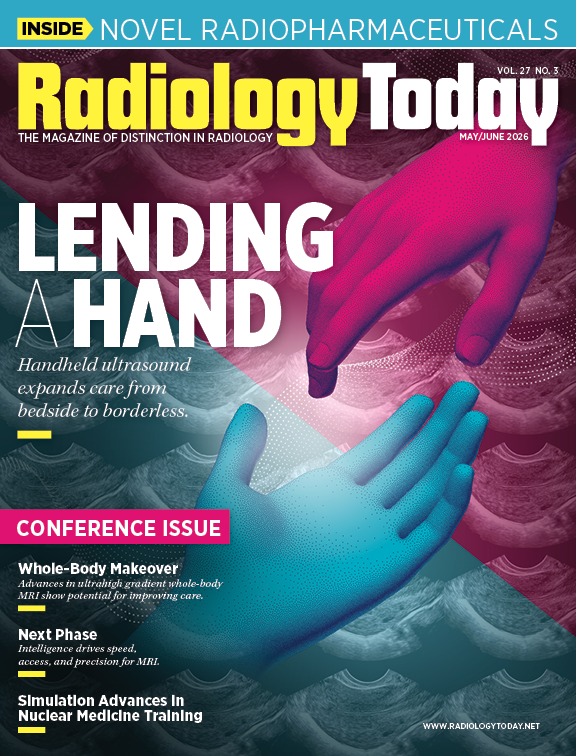
Lending a Hand
Handheld ultrasound offers access and speed with improving quality, and the technology is being adopted in an ever-growing variety of clinical scenarios.
FEATURE
Whole-Body Makeover
Ultrahigh gradient whole-body MRI is gaining attention among MRI experts.
|
|
|
| Advertising Opportunities |
Have a product or service you want to market to radiology professionals? Utilize the reach of Radiology Today Magazine to accomplish your marketing goals. Email our experienced account executives today at sales@gvpub.com or call 800-278-4400 for more information.
|
| © 2026 Radiology Today Magazine |
|
|