


BY CARRIE SCHMITZ, AOEAS, CHC
Mounting evidence confirms that increased investment in workplace ergonomics can have significant benefits for employees, from enhanced workflow and productivity to health improvements. While a high rate of musculoskeletal injuries among health care workers is well known, the dangers faced by radiologists are less obvious.
Given the conditions radiologists work in, it is no surprise that carpal tunnel, neck pain, and back pain are common. However, with the introduction of digital film and medical records, a new hazard has emerged for radiologists who remain stationary behind a desk for 10 to 12 hours per shift. Sedentary behavior can increase the risk of diabetes, cardiovascular disease, and cancer. What’s more, a study published in the Annals of Internal Medicine suggests that moderate to vigorous exercise for 30 minutes to one hour each day will not reverse the harmful effects of a daily sitting routine, if sitting takes place for more than 6 1/2 hours per day.
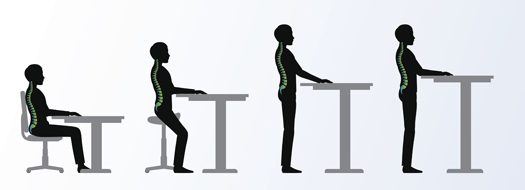
There are ways to combat this sedentary dilemma for a profession that, by its nature, requires prolonged screen time. For some, it may be as simple as incorporating more low-level activity into a work routine. This activity, such as alternating between sitting and standing frequently throughout the day, can offset some of the damaging effects of sedentary behavior. Following are some other simple tips for radiologists to consider when attempting to reduce prolonged sedentary time.
Where to Start
Adding simple movements to your daily routine can have long-term health benefits. The goal is to wind up your metabolism by activating your muscles. This isn’t about exercise, which could cause you to spend more time sitting later; it is about breaking up sitting time. One tip is to set a timer to go off every 30 minutes prompting you to move, eg, stretch your body, bend, fidget, or use a resistance band. Make a habit of alternating between sitting and standing throughout your shift. Fluctuating between the two positions has proven benefits including reduced back pain, increased productivity, blood pressure regulation, and improved mood states. According to a recent study that tested the impact of sit-stand interventions for workers, those who used sit-stand desks were 78% more likely to report a pain-free day than those who used regular workstations.
Find Excuses to Stand Up
When you get a phone call, stand up to answer it. If a coworker stops by your desk, stand up and talk to him or her. According to research, even small amounts of movement can add up in a big way. For example, one researcher says that standing three hours each day burns up to 30,000 extra calories, or eight pounds of fat, which is the equivalent to running ten marathons, in a year. Even stepping back and reading a screen from a standing position for a short time provides a boost to your system. If your monitor screens are adjustable, you will have more flexibility in viewing positions.
One way to offset musculoskeletal issues is to convert traditional sit-only desks into sit-stand workstations. Height-adjustable desks or wall-mounted solutions that allow users to view monitors at the correct ergonomic height can make long hours on the computer more comfortable. Considering that billed hours for radiology constitute such a large portion of total hospital income, it justifies making an ergonomic investment in this critical part of the health care team.
Restructuring the physical environment to fit the radiologist’s workstyle and job function will have a significant indirect influence on productivity. When radiologists are more comfortable in their physical space, they can do their job more efficiently, communicate with their health care team more effectively, and serve the patient population with better accuracy.
— Carrie Schmitz, AOEAS, CHC, is senior manager of human factors and ergonomics research at Ergotron.