


A PET image using F-18 THK5117, a novel tracer that labels neurofibrillary tangles with hyperphosphorylated tau deposition found in Alzheimer’s disease patients’ brains, was named the Image of the Year at SNMMI’s 2014 annual meeting in St Louis.
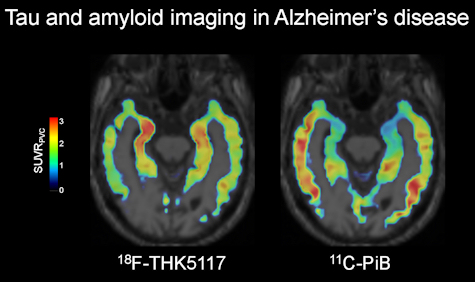
The tau/neurofibrillary tangles are one of two distinct pathological changes seen in Alzheimer’s disease patients’ brains; the other change is the presence of amyloid plaques. Other tracers, such as 11C-PiB and florbetapir F18, are designed to bind to amyloid plaques. Radiotracers that bind to tau/neurofibrillary tangles, such as F-18 THK5117, still are under development.
In the study at Tohoku University School of Medicine in Japan, Nobuyuki Okamura, MD, PhD, and his team had eight AD patients and six age-matched healthy control subjects undergo F-18 THK5117 PET scans for 90 minutes. PET scans were performed with C-11 PiB on the same population. Standard uptake value ratios were calculated 60 to 80 minutes postinjection for THK5117 and 40 to 70 minutes postinjection for PiB using the cerebellar cortex as the reference region. Partial volume correction, accounting for both gray matter atrophy and white matter spillover, was performed using PMOD 3.4 quantitative imaging processing software.
“In this study, the selective binding ability of F-18 THK5117 to tau was confirmed by the direct comparison with the amyloid PET tracer PiB,” Okamura said. “I hope that this technique will contribute to the development of new antidementia drugs.”
Alzheimer’s patients showed F-18 THK5117 retention in the lateral and medial temporal cortices, areas known to contain high concentrations of tau deposits. F-18 THK5117 standard uptake value ratios in these areas reached a plateau at 60 minutes postinjection. Regional distribution of F-18 THK5117 differed considerably from that of C-11 PiB in AD brains. F-18 THK5117 retention in the temporal cortex was correlated with dementia severity. In addition, F-18 THK5117 retention in the hippocampus was correlated with hippocampal volume in AD patients. Intriguingly, F-18 THK5117 retention in the right temporal lobe was observed in healthy control subjects with right temporal lobe atrophy.
“Dr Okamura’s work is in the forefront of such research,” said Satoshi Minoshima, MD, PhD, chair of the SNMMI Scientific Program Committee. “His group has successfully developed an F-18 labeled tracer, F-18 THK5117, that binds to tau/neurofibrillary tangles seen in Alzheimer’s disease. Owing to its longer half life, F-18–labeled tracers can potentially be distributed widely to many imaging centers.”
Tracers tagged with F-18 have an approximate half-life of 110 minutes compared with 20 minutes for PiB.
Minoshima also noted that the study demonstrated different distributions of amyloid tracer compared with tau/neurofibrillary tangle tracer in the study’s Alzheimer’s patients. The results could provide information about the pathogenesis and pathophysiology of Alzheimer’s and other dementias and may eventually lead to better diagnosis and treatments.
— Source: SNMMI