


Close Menu
  • Magazine
    • Current Issue
    • Issue Archive
    • Subscribe
  • Topics
    • AI/Machine Learning
    • CT
    • Fluoroscopy/C-Arm
    • General Radiology
    • Interventional Radiology
    • MRI
    • Nuclear Medicine/Molecular Imaging
    • PACS/RIS/Informatics
    • Radiation Oncology
    • Radiology Management
    • Reimbursement & Coding
    • Research News
    • Ultrasound
    • Women’s Imaging
  • E-Newsletter
  • Education
    • ARMRIT Annual Meeting
    • MRI Books
    • Webinars
  • Careers
  • Events
  • Resources
    • Product Directories
    • Resource Listing
    • Reprints
    • Writers’ Guidelines

Join Our Email List

Facebook X (Twitter) LinkedIn
Trending
  • Lending a Hand
  • Whole-Body Makeover
  • Next Phase
  • Beyond Anatomy
  • Editor’s Note: Steps Forward
  • Radiation Safety: Safety Check
  • AI Insights: Balancing the Load
  • Imaging Informatics: Connecting Silos
Friday, June 19
  • About
  • Contact
  • Advertise
  • Gift Shop
Facebook X (Twitter) LinkedIn
Radiology Today MagazineRadiology Today Magazine
Subscribe
  • Magazine
    • Current Issue
    • Issue Archive
    • Subscribe
  • Topics
    • AI/Machine Learning
    • CT
    • Fluoroscopy/C-Arm
    • General Radiology
    • Interventional Radiology
    • MRI
    • Nuclear Medicine/Molecular Imaging
    • PACS/RIS/Informatics
    • Radiation Oncology
    • Radiology Management
    • Reimbursement & Coding
    • Research News
    • Ultrasound
    • Women’s Imaging
  • E-Newsletter
  • Education
    • ARMRIT Annual Meeting
    • MRI Books
    • Webinars
  • Careers
  • Events
  • Resources
    • Product Directories
    • Resource Listing
    • Reprints
    • Writers’ Guidelines
Radiology Today MagazineRadiology Today Magazine
Home»Webinars»MRI Scanning at Low Field Strengths

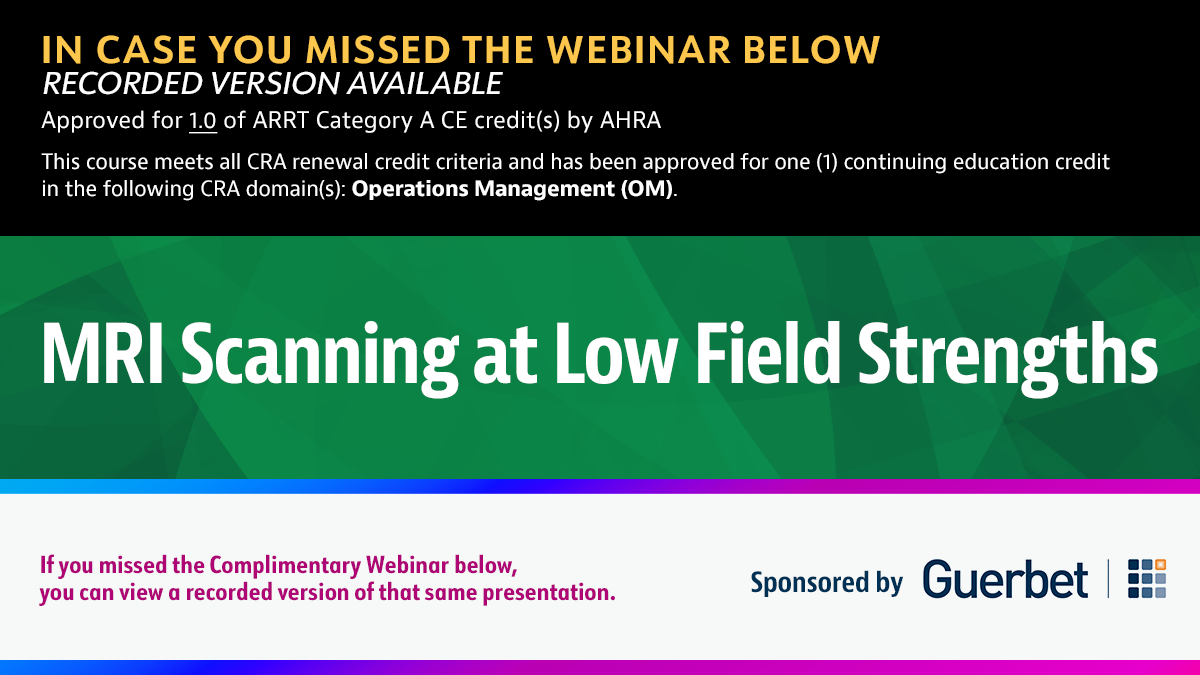
MRI Scanning at Low Field Strengths

Facebook Twitter LinkedIn Email Threads Bluesky Copy Link

With advancements making low-field MRI more accessible, low field scanning could become more widespread in imaging. It offers many advantages over high field MRI. With the help of advanced tools, overcoming challenges with low field scanning are possible. Low-field scanners generally pose less risk of heating from radiofrequency pulses and interactions with metallic implants, making it a great alternative to high field scanning. However, MRI safety is something to consider when performing low field imaging. It is not suitable for all examinations and careful patient screening is crucial.

Join Matt Rederer, MBA, RT(R)(MR)(CT)ARRT MRSO MRSE (MRSC) ARMRIT, for a discussion about the advantages and disadvantages of low‐field MRI scanners and safety protocols. The discussion will explore how low-field MRI can enhance diagnostic capabilities, especially in settings with limited resources, and expand accessibility to advanced imaging solutions. You will learn about the latest innovations in AI that are optimizing image quality and scan efficiency at lower field strengths. After participating in this session, you will be better equipped with the knowledge and practical strategies to maximize the potential of low-field MRI.

*To view the program, first select your profession. You will then be prompted to log-in to your Guerbet CE account or create a complimentary account for access.

View Recorded Version

Learning Objectives

After viewing this webinar the participants will be better able to:

  1. Discuss the need for low field imaging.
  2. List the benefits and disadvantages.
  3. Explain the MRI safety element to low field imaging.

Approved for 1.0 of ARRT Category A CE credit(s) by AHRA

This course meets all CRA renewal credit criteria and has been approved for one (1) continuing education credit in the following CRA domain(s): Operations Management (OM). The individual credit activity has satisfied CRA recertification requirements in connection with the Certified Radiology Administrator (CRA) program and has been approved under the listed domains.

This CE activity may be available in multiple formats or from different CE sponsors. ARRT does not allow self-learning CE activities (e.g., Internet courses, home study programs, directed readings) to be repeated for CE credit in the same CE biennium.

Some organizations may not allow CE credit to be awarded for completing the CE activity a second time even if the CE activity is presented in a different format such as: lecture, home study, or webinar. You should check with the organization requiring the CE credit for information specific to your professional credential requirements.

Share. Facebook Twitter Pinterest LinkedIn Tumblr Email

Related Posts

Program Directors: MRI Safety Educator Resources

January 8, 2026

Beyond the Image: A Paradigm Shift in Clinical Workflow with 3D Fusion and Augmented Reality

October 22, 2025

Next Generation MRI Contrast Agents: Application to Clinical Management and Workflow

November 9, 2023
  • Facebook
  • X
  • LinkedIn

E-Newsletters

A trusted resource for industry professionals, Radiology Today reports the latest news and information that matters to radiologists, radiology administrators, and technologists.

1721 Valley Forge Road #486, Valley Forge, PA 19481
Phone: 800-278-4400 or 610-948-9500
Subscriptions: 833-790-6897

Facebook X (Twitter) LinkedIn

Subscribe

  • Home
  • Subscribe
  • About
  • Contact
  • Advertise
  • Privacy Policy
  • Terms & Conditions
© 2026 Radiology Today Magazine. All rights reserved.

Type above and press Enter to search. Press Esc to cancel.